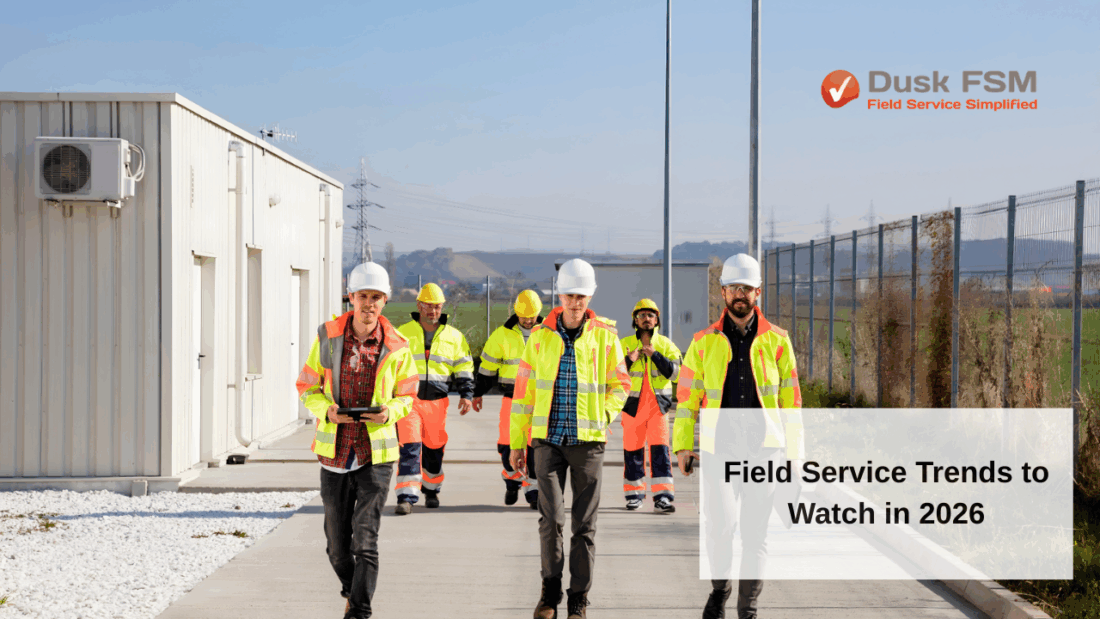
Adapting to Change: Key Field Service Trends to Watch in 2026
If you work in field service today, you can probably feel the ground shifting already. The way you scheduled jobs five years ago, the way your technicians updated work statuses, the way your office team handled customer calls or delays, none of it behaves the same anymore. Field work is moving faster. Customer expectations are sharper. And the pressure to maintain visibility across crews, contractors, and changing priorities keeps growing every season.
As you head into 2026, the pace of that change will only intensify. Teams that once relied on paper forms, radio calls, spreadsheets, or scattered apps are discovering that manual coordination cannot keep up with the scale and complexity of modern field work. You need the kind of support that helps you adapt on the fly, not tools that force you to slow down just to manage the basics. That is why more leaders are looking closely at mobile field service management software that gives them the flexibility and control they have been missing.
The pace of technological advancement is reshaping what “good” looks like in day-to-day service delivery. What was acceptable last year will not hold up in the year ahead. For many leaders, the challenges are familiar: technician shortages, rising service demand, increasingly specialized work, tighter SLAs, expanding service territories, and the limitations of manual coordination. But in 2026, these pressures will converge in a way the industry has not experienced before. This convergence is forcing organizations to rethink how they plan, schedule, communicate, and execute work.
This blog walks you through the trends that matter most for the year ahead, especially if you are ready to simplify your operations, build more responsive teams, and move toward field service management made simple. The goal is not to overwhelm you with predictions. The goal is to help you understand what is coming next so you can step into 2026 with clarity and confidence. With that in mind, let’s look at the trends that will shape your operational decisions in 2026.
Trend 1: Predictive Automation Becomes the Backbone of Scale
If there is one shift you will feel most strongly in 2026, it is the rise of automation that helps you think and act faster. Predictive scheduling, automated job routing, real time adjustments, and workflow triggers are no longer advanced features that only large enterprises use. They are quickly becoming the standard for any team that wants to reduce manual work and operate with fewer daily bottlenecks.
When automation supports your decisions, your dispatchers spend less time juggling schedules and more time guiding the day. Technicians get clearer instructions and fewer last minute changes. Customers receive better communication and shorter waiting times. And you get the confidence that your jobs are flowing through a consistent, structured process every time. This is where systems like Dusk FSM help you modernize how you run your day, from how to set up jobs in the Dusk FSM platform to how your team updates work in the field through the mobile field service app.
Predictive automation does not replace the people on your team. It removes the noise around them. It reduces the guesswork, the repeated tasks, the reactive scheduling, and the endless manual adjustments that can drain even your best dispatchers. And once your workflows are standardized and automated, you will feel a noticeable shift. Your operations become lighter, faster, and far more resilient as they scale.
Trend 2: Real Time Visibility Becomes Your Daily Superpower
If you have ever tried to manage a full day of field work without real time visibility, you know how quickly things can fall out of sync. A technician runs late. A part is missing. A job takes longer than expected. A customer calls in with a change. Without a clear picture of what is happening right now, you end up making decisions in the dark and hoping for the best.
In 2026, that approach simply will not hold. The teams who perform best will be the ones who can see everything as it is happening. Live job status, technician availability, inventory readiness, SLA risks, customer updates. When this information flows through a mobile field service software instead of scattered messages and manual check-ins, you can make adjustments in minutes rather than hours.
Visibility is not data for the sake of data. It is the clarity that lets you shift work quickly, support technicians faster, and keep customers informed without losing time. A mobile FSM system with scheduling and mobile updates gives your office team the insight they need to stay in control, even as the day evolves.
You cannot respond effectively to what you cannot see. Real time visibility is what turns complex operations into manageable ones.
Trend 3: Workforce Pressures Are Reshaping How You Operate
If you manage field teams right now, you already feel the pressure. Technicians are harder to hire. Experienced workers are retiring. The skills required to service modern equipment keep expanding. These realities are not slowing down in 2026. They are accelerating.
This means you need to support your workforce in smarter ways. You need tools that shorten onboarding, guide technicians in the field, and provide structure across a blended workforce of employees and contractors. You also need workflows that protect your experienced technicians from burnout and give your newer technicians the confidence to deliver quality work.
This is where your mobile field service management software becomes more than a digital clipboard. It becomes your on-the-job support system. When job details, forms, checklists, photos, and customer notes are all accessible through a mobile field service app, your technicians can work with clarity, no matter their level of experience.
Some teams even use digital tools to keep knowledge inside the business rather than losing it when a senior tech leaves. Others use automation to reduce the repetitive tasks that slow down their crews. The theme is the same. To adapt to workforce challenges in 2026, you need systems that make your people stronger, faster, and more supported in the field.
Trend 4: Customer Expectations Are Now Driving Your Operational Speed
Your customers have changed. They want faster scheduling. They want accurate arrival windows. They want updates without having to call. They want technicians who know the history of the job before they arrive. And they want everything to feel connected from quote to completion.
These expectations are raising the bar for field service operations everywhere. When customers expect more clarity and more control over their service experience, they indirectly push your entire operation to become more adaptable and proactive. You cannot deliver a smooth, consistent experience with tools that slow you down or workflows that depend heavily on manual handoffs.
This is why so many leaders are looking for field service management made simple. They want to simplify the customer journey, standardize communication, and reduce the delays that frustrate customers most. When your scheduling, job updates, and technician workflows all run through a unified system, your customers feel the difference. And so does your team.
Customer expectations will not soften in 2026. If anything, they will rise again. The good news is that when you adapt your operations to meet those expectations, everything else becomes easier too. Your day becomes smoother. Your technicians feel more supported. And your customers stay with you longer.
Trend 5: Integration Becomes the Foundation of Agility and Cost Control
If you have ever felt the strain of bouncing between systems just to understand what is happening in your operation, you are not alone. Many field service teams still rely on a mix of spreadsheets, stand-alone apps, accounting tools, and separate CRM systems. Each one solves a piece of the puzzle, but when they do not speak to each other, you lose time, accuracy, and momentum.
In 2026, integration becomes one of the strongest predictors of operational success. When your CRM connects to your field service platform, when your job data maps cleanly to your invoices, when your inventory updates flow automatically to technicians in the field, you eliminate the friction that slows down your day. You also prevent the small misalignments that grow into costly mistakes.
This is why so many leaders are leaning toward a mobile FSM system with scheduling and mobile workflows built into the core. When the systems behind your scheduling, dispatching, billing, customer communication, and field activities work together, your entire operation feels more predictable and more controllable. Instead of managing data manually, you manage the work itself.
Integration does not have to be complicated. It simply has to be consistent. And once you experience a connected workflow, it becomes difficult to imagine running your operation any other way.
Trend 6: Sustainability Emerges as a Smart Operations Strategy
Sustainability is not just about being environmentally responsible. In field service, it is becoming one of the most practical ways to improve efficiency and lower costs. If you can reduce travel time through smarter routing, you save fuel and increase technician capacity. If you can reduce paper forms by moving to a mobile field service software, you shorten back office processing time. If you can maintain equipment more predictively, you avoid expensive breakdowns and unnecessary site visits.
These types of sustainability initiatives are appearing everywhere, not as corporate mandates but as operational wins. They make your workload lighter. They help your technicians use their time better. They reduce avoidable expenses. And they help you deliver a smoother experience to customers.
For some teams, the shift begins with route optimization. For others, it begins with digital job forms or predictive maintenance. The starting point does not matter as long as you choose something that simplifies your day. One change leads to the next, and before long, sustainability becomes a natural part of how you operate, not a separate initiative.
Sustainability is not a trend you adopt because you have to. It is a trend you adopt because it improves your business from the inside out.
Bringing It All Together: The Agility Equation for 2026
When you look across these trends, a clear pattern emerges. Everything is pointing you toward a more adaptive, integrated, and insight-driven way of working. Automation reduces the heavy lifting. Real time visibility removes uncertainty. Workforce support strengthens your teams. Integration reduces friction. Sustainability reduces waste. And rising customer expectations sharpen your operational standards.
This is the agility equation for 2026.
It is not about having the biggest team or the most trucks on the road.
It is about having the clarity and flexibility to adjust quickly, make better decisions, and keep your work flowing smoothly even when conditions change.
If you think about the days when everything goes smoothly, they usually have one thing in common. It’s not that there was no disruption or unexpected events happening, but that you and your team can adjust quickly. A technician calls in sick. A customer needs to shift their appointment. A high priority job lands unexpectedly. When your systems and workflows support agility, you can absorb these changes without losing momentum. When they do not, even a small disruption can ripple across the entire schedule.
Operational agility is becoming the quality that separates teams who stay ahead from those who spend their days trying to catch up. As your field operations grow, the complexity grows with them. More job types, more technicians, more contractors, more moving parts. At a certain point, experience and intuition cannot manage it alone. You start to depend on tools that give you real visibility, tighter coordination, and faster decision making. That is where the right mobile FSM system with scheduling and mobile workflows becomes less of an upgrade and more of a foundation.
Agility is not just about reacting. It is about having the structure and clarity to stay one step ahead. And in 2026, that ability will be the difference between teams who thrive and teams who feel overwhelmed.
Your 2026 Readiness Checklist
Adapting to the trends shaping 2026 does not require sweeping transformation on day one. What you need is a practical starting point, something that helps you create momentum without overwhelming your teams. The checklist below is designed to help you build that foundation. Use it as a guide to strengthen agility, simplify your workflows, and improve the way you manage your field operations.
Here are the areas to focus on:
✔ Identify the operational friction points that slow your day.
Look at recurring delays, repeated rescheduling, long customer wait times, or gaps in communication. These patterns often reveal where your processes need more structure or support.
✔ Standardize the workflows your team uses most often.
When your job types, checklists, and forms are consistent, automation becomes easier to implement and your mobile field service management software becomes far more effective.
✔ Choose one high impact area to automate first.
Predictive scheduling, real time job updates, and automated work status changes often deliver the fastest wins.
✔ Strengthen visibility across your jobs and technicians.
A mobile FSM system with scheduling and mobile updates gives you the real time insight you need to keep your day under control.
✔ Connect the systems that should already be talking to each other.
If your CRM, field operations, and billing still feel disconnected, start evaluating integrations that will remove manual handling and prevent data gaps.
✔ Support your technicians with better on the job tools.
Mobile checklists, structured job information, and clear routing make the workday smoother, especially for newer technicians.
✔ Reduce waste where it matters most.
Route optimization, digital documentation, and preventive maintenance allow you to improve sustainability while lowering costs.
✔ Take one step in the next 30 days.
Even a small improvement helps your team build confidence and lays the foundation for bigger changes ahead.
This checklist is not the finish line. It is the starting point that helps you create stability while you scale.
The Path Forward
If you want your field operations to run with more clarity, more predictability, and more resilience in 2026, this is the time to start adapting. The industry is moving quickly, and the pressure on field teams keeps rising. But the tools available to you are stronger than ever. With the right mix of automation, visibility, workforce support, and system integration, you can create an operation that feels calmer, more coordinated, and more capable of handling whatever comes next.
Whether you are exploring new mobile field service software, refining your scheduling workflows, or simply trying to simplify field service management, the next few months are an opportunity to build momentum. You do not need to upgrade everything at once. You just need to start in the right place and keep moving forward.
A modern, connected platform like Dusk FSM can help you make that shift by giving you clearer data, more consistent workflows, and mobile tools that keep your field teams aligned with your office. But the bigger transformation comes from your willingness to evolve your operation and embrace agility as a core strength.
2026 is not the year to play catch up. It is the year to get ahead.
If you are ready to simplify your workflows, strengthen your field teams, and build the agility your operation needs for 2026, this is the moment to take the next step. Explore how Dusk FSM can support your journey toward a more connected, more predictable, and more adaptive field service operation.
Takeaway Tip
Ready to see the difference?
Get started with the Dusk FSM Platform and see the benefits from streamlining your field operations with a single, comprehensive view of your business in real time. Start collaborating today and excelling in customer service. Read more on our platform capabilities here and a dedicated YouTube playlist here.
Get Started Today
Not sure where to start? Request a demo from our team via the button below:
Book a Demo
Or you just have some questions: