
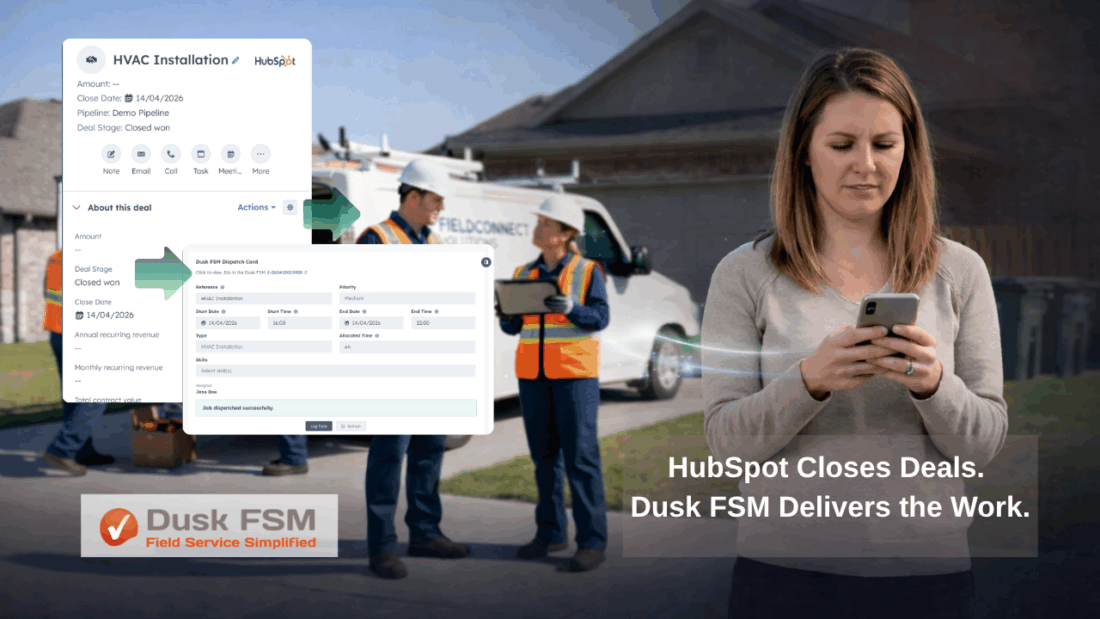
Why HubSpot Users Add Dusk FSM When They Scale Field Work
If you are using HubSpot to manage your field service business, you already have a strong operational foundation. You can track your pipeline, manage customer relationships, and maintain visibility across deals, tickets, and communication.
In the early stages of growth, this works extremely well. A deal is closed, a ticket is created, and someone on the team takes ownership of delivering the work. Coordination happens through a mix of internal communication, shared documents, and team knowledge.
However, as your field operations begin to scale, the nature of the challenge changes. You are no longer managing a handful of jobs. You are managing dozens, sometimes hundreds, across multiple technicians, locations, and timelines. At this point, the questions you need answered become more operational in nature.
- Who is assigned to each job, and are they the right fit based on skill and availability?
- When is the work scheduled, and how does it align with other commitments?
- What is happening in the field in real time?
- Has the work been completed accurately, and is it ready for billing?
These are not edge cases. They become daily requirements.
The challenge is not that your CRM stops working. It is that your operations have outgrown what a CRM is designed to handle. HubSpot continues to manage customer relationships effectively, but it does not provide the level of control required to plan, execute, and monitor field work at scale.
This is the point where many growing field service teams begin to recognize that managing customer data and managing field execution are two different problems, each requiring its own system.
The Execution Gap: Where CRM Stops and Field Work Begins
When a deal is marked as closed in HubSpot, it represents a commitment to deliver a service. From a revenue perspective, that milestone is important. From an operational perspective, it is simply the starting point.
The work still needs to be translated into actionable steps. Jobs must be created, scheduled, assigned, and tracked through completion. This is where the execution gap begins to emerge.
A CRM is designed to capture intent. It tells you what has been sold and to whom. It does not manage how that work is executed in the field.
Without a connected operational layer, teams often rely on manual coordination to bridge this gap. Jobs are tracked in spreadsheets, technician assignments are handled through calls or messages, and updates are recorded in multiple places. Over time, this leads to duplicated effort, delayed information, and limited visibility across the organization.
As the volume of work increases, these inefficiencies become more pronounced. Small delays in communication can lead to missed appointments. Incomplete information can result in technicians arriving unprepared. Disconnected updates can slow down invoicing and impact cash flow.
To address this, field service organizations need more than a CRM. They need a system that can translate customer and deal data into structured, executable work. For many teams, the goal at this stage is not to introduce another system. It is to avoid adding complexity to the one they already rely on.
In some cases, that means adopting a full field service management platform. In others, it means extending HubSpot with a lightweight execution layer that allows dispatch, scheduling, and job tracking to happen without leaving the CRM.
The requirement is the same in both cases. Work needs to move from deal to execution without friction. This is where mobile field service management software becomes critical. By connecting directly with your CRM, it ensures that work is created, scheduled, and managed within a system designed for real-world execution.
A mobile FSM system with scheduling and mobile capabilities allows your team to assign jobs based on availability and skill, adjust schedules dynamically, and track progress in real time. Field technicians can access job details, update status, and capture information directly from a field service app, ensuring that data remains accurate and up to date.
Instead of relying on manual processes, your operations become structured and predictable. Work flows from deal to execution without unnecessary handoffs, and your team gains the visibility needed to manage performance at scale.
This is what makes field service management simple in practice. It is not about reducing complexity in the business. It is about ensuring your systems can handle that complexity without slowing your team down.
Growth Creates Misalignment, Not Just More Work
As your field operations grow, the challenge is not just handling more jobs. It is keeping your teams aligned as the volume and complexity increase.
At a smaller scale, alignment happens naturally. Teams are closely connected, and most people have a shared understanding of what is happening across the business. Sales, operations, and field teams can rely on direct communication to stay in sync.
As you scale, that shared understanding starts to break down. Different teams begin to operate within their own systems and workflows. Sales focuses on closing deals, operations on scheduling and dispatch, and finance on billing and reporting. Each function becomes more efficient individually, but less connected collectively.
This is where misalignment begins to surface. You start to see patterns like:
- A deal is marked as closed, but the job has not yet been scheduled
- Operations is managing capacity, but sales is unaware of delays
- Field technicians receive incomplete context before arriving on-site
- Finance is waiting on job completion data that has not been updated
Individually, these are small gaps. Together, they create friction across the entire operation.
The impact is not always immediate, but it compounds over time. Teams spend more time clarifying information than acting on it. Internal communication increases, but without improving clarity. Reporting becomes less reliable because data is not synchronized. Most importantly, customers begin to experience inconsistencies in timelines and communication.
This is the point where growth stops feeling like progress and starts introducing operational strain. To move forward, you need more than visibility within each team. You need a shared operational layer that connects all stages of work, from deal to execution to completion.
A mobile field service management software integrated with your CRM helps establish that connection. Once a deal is closed, the corresponding work is created, scheduled, and tracked in a structured way, with updates flowing across teams in real time.
Instead of relying on constant follow-ups, your teams operate with a shared understanding of what is happening. That is what allows alignment to scale with the business.
The Breaking Point: Manual Workflows Do Not Scale
In the early stages of a field service business, manual workflows often feel efficient. Teams rely on spreadsheets, emails, and direct communication to coordinate work, and because the volume is manageable, this approach appears flexible and responsive.
For a while, it works. As operations grow, however, the same processes begin to create friction. The number of jobs increases, schedules become more complex, and coordination requires significantly more effort.
What was once simple starts to feel unpredictable. You begin to notice recurring issues:
- Scheduling conflicts and double bookings
- Jobs slipping through the cracks
- Technicians arriving without complete information
- Increasing time spent on administrative coordination
These are not isolated problems. They are signals that the current way of working has reached its limit.
The underlying issue is that manual workflows rely on people to manage complexity. As the number of variables increases, this becomes unsustainable. Teams spend more time managing exceptions than executing work. At this point, scaling requires a shift in how operations are structured.
Instead of coordinating work manually, you need systems that can orchestrate it consistently.
A mobile field service software platform introduces that structure. Jobs are created in a standardized format, scheduling takes into account availability and workload, and updates are captured directly from the field through a field service app. This ensures that information remains accurate and accessible without requiring constant manual input.
The goal is not to eliminate complexity, but to manage it more effectively. That also means avoiding systems that introduce unnecessary layers or require teams to adapt their workflows just to fit the tool.
With a free FSM system with scheduling and mobile capabilities, teams can begin to move away from reactive coordination and toward a more predictable operating model. Work is planned, executed, and tracked within a system designed for scale. That shift is what allows operations to remain reliable as the business grows.
Customer Experience Becomes an Operational Responsibility
As your business grows, customer experience is no longer defined by how well you sell. It is defined by how consistently you deliver.
In the early stages, this distinction is not always obvious. Sales conversations, responsiveness, and relationship management shape how customers perceive your business. But as field operations scale, the experience shifts away from the sales cycle and into execution.
What the customer actually remembers is not the deal. It is the service.
- Whether the technician arrived on time.
- Whether they had the right information.
- Whether communication was clear throughout the process.
- Whether the job was completed as expected.
These moments are operational, not transactional. Customers may not see your systems, but they experience the outcomes of how well those systems are connected.
At scale, even small inconsistencies begin to stand out. A delayed update, an unclear schedule, or a missed expectation can quickly impact how reliable your business feels. Over time, these experiences shape customer trust more than any single interaction.
This is where many teams encounter a gap.
They have strong CRM processes, but limited control over how service is delivered in the field. Communication becomes reactive instead of proactive. Visibility is partial rather than real time. Consistency becomes difficult to maintain across teams and locations.
The result is not necessarily poor service, but inconsistent service. And inconsistency is what customers notice most.
To address this, customer experience needs to be treated as an operational outcome. It requires systems that provide real-time visibility, structured workflows, and consistent communication across every stage of the job lifecycle.
A mobile field service management software plays a critical role here. By connecting scheduling, execution, and updates within a single system, it ensures that customers receive clear timelines, accurate information, and predictable service delivery.
This is where a mobile FSM system with scheduling and mobile capabilities directly impacts customer perception. Technicians are better prepared, updates are captured in real time, and teams can communicate proactively rather than reactively.
Trust, in this context, is not built through exceptional moments. It is built through consistency.
The Shift Smart Teams Make: Extend, Don’t Replace HubSpot
At this stage, many growing field service teams begin to ask a familiar question. Do we need to replace our CRM to support field operations?
It is a reasonable concern. As complexity increases, the instinct is often to look for a single system that can handle everything. But in practice, replacing a CRM like HubSpot introduces more disruption than clarity.
The issue is not that your CRM is insufficient. It is that it was never designed to manage field execution.
HubSpot continues to serve an essential role as your system of record. It manages customer relationships, tracks deals, and provides visibility into your pipeline. These capabilities remain critical as your business grows.
What is missing is not functionality within the CRM, but a connected operational layer that can handle how work is planned and delivered in the field.
This is where the shift happens. Instead of replacing HubSpot, high-performing teams extend it with a mobile field service management software that is purpose-built for execution. This approach allows each system to do what it is designed for, while ensuring they work together seamlessly. In practice, this often comes down to how simply work can be dispatched and managed. For many teams, the need is not a complex dispatch engine, but a clear and efficient way to assign and track work without stepping outside HubSpot.
To understand this more clearly, it helps to separate the two roles:
- Your CRM captures intent. It answers what has been sold, to whom, and under what terms
- Your FSM platform manages execution. It determines how that work is scheduled, assigned, and completed
When these two layers are connected, your workflow becomes continuous rather than fragmented.
- A closed deal can automatically trigger job creation.
- Scheduling can take into account real-world constraints such as technician availability, location, and workload.
- Field teams can access job details through a field service app, update progress in real time, and ensure that completion data is captured accurately.
That information then flows back into your CRM, giving sales, operations, and finance a consistent and up-to-date view of what is happening. This eliminates a large portion of the manual coordination that typically exists between systems.
More importantly, it creates a predictable operating model. Instead of relying on follow-ups, internal checks, and ad-hoc updates, your teams work within a structured process where each stage of the job lifecycle is clearly defined and visible.
This is where a mobile FSM system with scheduling and mobile capabilities becomes essential. It allows your business to scale without introducing additional layers of complexity. Field service management made simple, in this context, is not about reducing functionality. It is about ensuring that your systems are aligned, so that work flows naturally from one stage to the next. For a deeper understanding of how CRM and field execution are connected at a system level, you can explore the integration structure here: Dusk FSM HubSpot Integration Docs.
By extending HubSpot with a mobile field service software platform like Dusk FSM, you create a connected environment where customer data and field execution operate as a single system. That is what allows you to scale with confidence.
Choose an FSM that fits your workflows
One of the most common mistakes at this stage is overcorrecting. Teams move from manual workflows to systems that introduce too much structure, too many layers, and too much operational overhead.
At this stage, the question is no longer whether you need an execution layer. It is how to choose one that will support your operations as they scale.
This is where many teams run into a second challenge.
They adopt a field service platform, but quickly find that it either forces them into rigid workflows or introduces a level of complexity that slows the team down. Instead of improving operations, the system becomes something that needs to be managed alongside the work itself.
For a field service organization that is already scaling, that trade-off does not work. What you need is a platform that aligns with how your business operates today, while remaining flexible enough to adapt as that model evolves. This is where Dusk FSM is positioned differently.
Rather than attempting to replace your CRM, it is designed to extend it. The integration with HubSpot ensures that customer data, deal activity, and field execution remain connected, without requiring duplicate systems or manual coordination between teams.
From an operational standpoint, the platform focuses on three things that become critical at scale.
- First, structure. Work is created and managed in a way that reflects how your services are actually delivered. Jobs are not just entries in a system. They are tied to workflows, resources, and real-world constraints.
- Second, visibility. Teams are not working in isolation. Managers, dispatchers, and field technicians all operate with access to the same, real-time information. This reduces the need for follow-ups and allows decisions to be made with confidence.
- Third, adaptability. As your business grows, your workflows will change. New service types, new regions, and new operational requirements will emerge. The system needs to accommodate that without requiring a complete rebuild.
This combination is what allows a mobile field service management software to support growth rather than limit it. Dusk FSM is designed with that balance in mind. It provides the structure required to standardize operations, while maintaining the flexibility needed to adapt over time.
In practice, this means your team is not adjusting to the system. The system adjusts to your operations. This allows teams to adopt the level of structure they need, without being forced into complexity they do not need.
Scaling Field Work Without Losing Control
Scaling a field service business is not just about increasing the number of jobs you can handle. It is about maintaining control as that volume increases.
In the early stages, control comes naturally. Teams are closely connected, communication is direct, and most decisions are made with full context. As operations grow, that clarity becomes harder to maintain. More jobs, more technicians, and more variables introduce complexity that cannot be managed through coordination alone.
This is where many teams begin to feel the strain.
Work is still getting done, but it takes more effort to keep everything aligned. Teams rely on follow-ups to confirm status. Information is spread across systems. Decisions are made with partial visibility. Over time, this slows the organization down and introduces inconsistency in how work is delivered.
Scaling without structure leads to unpredictability. To maintain control, the operating model needs to evolve. Systems must take on a larger role in managing how work flows across the business, from the moment a deal is closed to the point where the job is completed and ready for billing.
A mobile field service management software provides that structure. By introducing a mobile FSM system with scheduling and mobile capabilities, you create a connected workflow where each stage of the job lifecycle is clearly defined and visible. Work is planned with real-world constraints in mind, updates are captured directly from the field through a field service app, and teams operate with access to accurate, real-time information.
This changes how the business runs on a day-to-day basis. Instead of reacting to issues as they arise, your team can manage operations proactively. Scheduling becomes more reliable. Communication becomes more consistent. Reporting reflects what is actually happening in the field, not what was expected to happen.
Over time, this creates a more predictable and scalable operation.
For many teams, the transition begins with a free FSM system with scheduling and mobile capabilities, allowing them to introduce structure without significant upfront complexity. As operations grow, that foundation becomes critical in supporting more advanced workflows and higher volumes of work.
The goal is not to reduce the complexity of your business. It is to ensure that your systems are capable of handling it. Because in the end, scaling is not about doing more work. It is about delivering that work consistently, clearly, and with confidence.
If you are already using HubSpot and starting to feel the strain of growing field operations, this is the right time to evaluate how your execution layer is set up.
Explore how Dusk FSM extends HubSpot to manage scheduling, field execution, and real-time visibility without adding operational complexity.
Ready to see the difference?
Get started with the Dusk FSM Platform and see the benefits from streamlining your field operations with a single, comprehensive view of your business in real time. Start collaborating today and excelling in customer service. Read more on our platform capabilities here and a dedicated YouTube playlist here.
Get Started Today
Not sure where to start? Request a demo from our team via the button below:
Book a Demo
Or you just have some questions: