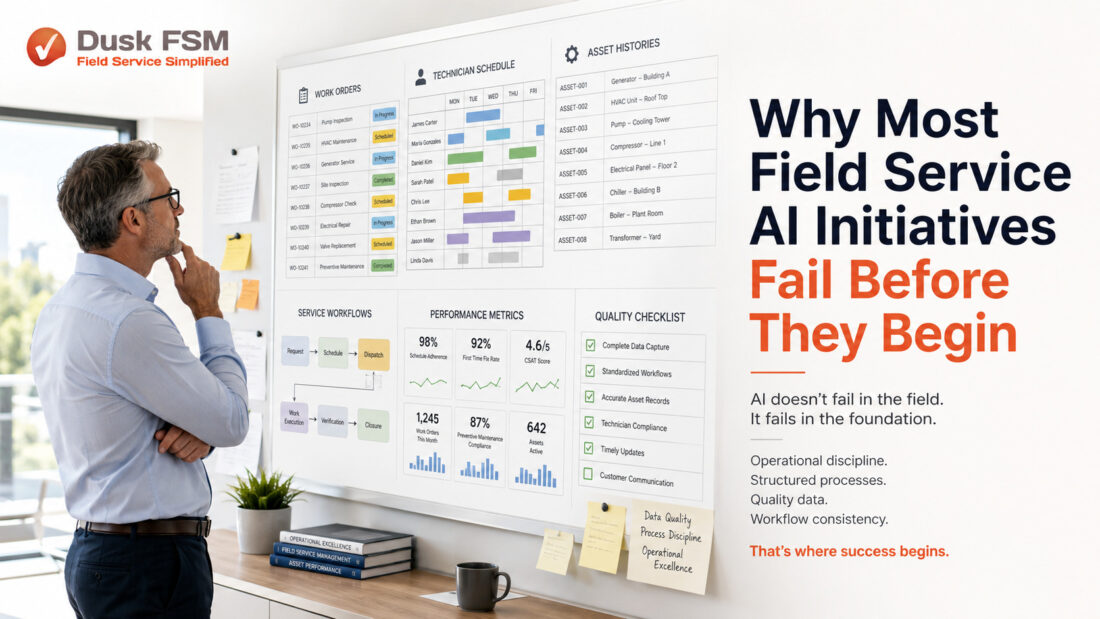
Why Most Field Service AI Initiatives Fail Before They Begin
AI is moving fast across field service.
Smarter scheduling. Faster diagnostics. Better technician support. Cleaner reporting. More automation.
Everywhere you look, service leaders are being asked the same questions. What is your AI strategy? How will you automate more of your operation? Can AI improve technician productivity, customer communication, scheduling and reporting?
They are fair questions. But they often start in the wrong place.
This article grew out of a recent conversation between us about what it really takes for AI to succeed in field service. Although we come from different perspectives, technology and software on one side, operational leadership on the other, we reached the same conclusion. AI success depends far more on operational readiness than on the AI itself.
One example from Erick’s experience stood out. An AI initiative had access to roughly 65,000 historical service cases. On paper, it looked like exactly the type of dataset AI should thrive on.
In reality, the first challenge wasn’t intelligence.
It was usability.
Before AI could learn from the information, the data had to be cleaned, translated, categorized and standardized. Years of operational history existed, but it had been captured differently across teams, systems and individuals.
That experience highlights a truth many organizations overlook. AI does not work in isolation. It learns from the data, workflows, decisions and habits already inside your business. If those foundations are inconsistent, AI will not quietly fix them. It will expose them.
That is why many field service AI initiatives struggle long before the technology becomes the problem. The challenge is usually operational readiness.
The AI Readiness Myth
Most organizations begin their AI journey with outcomes in mind.
Can AI reduce administration?
Can it improve scheduling?
Can it increase first-time fix rates?
Can it summarize customer history?
Can it help technicians resolve issues faster?
These are all worthwhile goals. However, they are not the starting point.
The starting point is operational maturity.
As Erick Jorgenson observed, “AI can make you faster and better at what you already do. It doesn’t make you smarter.”
Organizations that achieve meaningful AI outcomes are rarely the ones chasing the newest tool. They are the ones that have already established structured data, repeatable workflows, captured knowledge and measurable performance.
AI readiness is not a technology initiative. It is the outcome of operational discipline.
A Practical AI Readiness Check
Before investing heavily in AI initiatives, ask yourself:
- Are work types and job categories standardized?
- Is technician knowledge captured consistently?
- Can you easily view history by customer, asset and technician?
- Are workflows documented and followed consistently?
- Can managers trust the underlying data?
- Do you measure operational performance today?
If several of these questions are difficult to answer, your biggest opportunity may not be AI. It may be strengthening the foundation underneath it.
Pillar 1: Structured Data
Most field service organizations already have an abundance of information.
Work orders. Asset records. Customer histories. Inspection forms. Technician notes. Photos. Dispatch updates.
The challenge is not availability. The challenge is consistency.
The 65,000-case example demonstrated this clearly. The issue was not a lack of data. The issue was that the information had been captured in too many different ways. Some records were rich with context. Others were incomplete, inconsistent or cluttered.
Structured data creates a common language across the operation. It makes information easier to search, report on and ultimately learn from.
As we discussed, AI is only as effective as the information it receives. As Alan puts it, “What comes out is only as good as what goes in.”
Organizations preparing for AI should focus on making critical information easier to capture consistently, including job types, issue categories, asset details, completion outcomes and customer approvals.
Pillar 2: Capturing Operational Knowledge
Some of the most valuable knowledge in a service organization never makes it into a system.
It lives in experienced technicians, dispatchers and service managers.
These people know which assets fail repeatedly, which customers require special handling and which workarounds have solved similar issues before.
The problem is that this knowledge is fragile.
When experienced employees leave, much of that context leaves with them.
AI can help surface and distribute knowledge. It cannot learn from knowledge that was never
captured.
This is why modern field service platforms should do more than dispatch work. They should help organizations build operational memory through notes, forms, photos, asset history and customer context.
If your best knowledge exists only in conversations and personal notebooks, your first AI opportunity may not be automation. It may be knowledge capture.
Pillar 3: Operational Consistency
AI performs best in environments that are predictable.
Not rigid. Predictable.
Field operations will always require flexibility. Customers reschedule. Assets behave differently. Technicians make judgement calls.
However, flexibility should not mean every team follows a different process.
When statuses are used differently, reporting becomes unreliable. When completion details are captured inconsistently, visibility suffers. When workarounds exist outside the system, improvement becomes difficult.
During our discussion, we kept coming back to the same idea. As Erick put it, “AI will make assumptions if the process isn’t clearly defined.” That led to a simple conclusion: AI can’t optimize chaos.
Before introducing AI into a workflow, leaders should ask whether the process is documented, followed consistently and measurable.
Trust and Adoption
Technology does not create adoption. People do.
For leaders, trust means visibility, accountability and confidence in decisions.
For technicians and schedulers, trust is simpler. Does it save time? Does it reduce administration? Does it provide better information?
If a tool helps people do their jobs, they will use it. If it creates friction, they will work around it.
The same principle applies to AI.
The most successful AI initiatives keep humans responsible for judgement and accountability while allowing technology to surface information, summarize context and reduce repetitive work.
Measure Before You Optimize
Many AI conversations begin with broad objectives such as improving efficiency, increasing productivity or reducing costs.
These goals are important, but they are not enough.
Before AI can improve performance, you need to understand current performance.
Whether measuring first-time fix rates, technician utilization, scheduling efficiency, SLA performance or customer satisfaction, the starting point is having a trusted baseline.
AI becomes more valuable when it is connected to measurable operational outcomes rather than assumptions.
Build the Foundation Before AI Arrives
The future of field service will absolutely include more AI.
The question is not whether AI will become part of service operations.
The question is whether your operation will be ready to benefit from it.
If your data is inconsistent, AI will inherit inconsistency.
If your workflows vary from team to team, AI will inherit variability.
If your knowledge is trapped in people’s heads, AI will inherit the gaps.
If your team does not trust the system, AI will struggle to gain adoption.
AI is not a shortcut to operational excellence.
It is an amplifier of it.
From both an operational and technology perspective, we believe the organizations that benefit most from AI won’t necessarily be the first to adopt every new tool. They’ll be the ones that build stronger service operations today through structured data, captured knowledge, consistent workflows, trusted systems and clear measurement.
That is where AI success begins.
Continue the Conversation
Whether you’re exploring AI, reviewing your operational foundations, or simply looking for ways to improve your field service operation, the most important step is understanding where you are today.
If you’d like to learn more about the operational principles discussed in this article, explore the Dusk FSM platform, or continue the conversation with us, we’d love to hear from you.
Book a Conversation
Or you just have some questions: